Skull crushers with dumbbells are one of the most effective exercises for building strong triceps. Many people see the movement in gyms or online, but few perform it correctly. If you want bigger, stronger arms, learning how to do skull crushers with dumbbells can help you reach your goals faster and safer.
This article shows you step-by-step how to master the exercise, avoid mistakes, and get the best results. You will also discover tips, common errors, and how to add skull crushers to your workout routine.
What Are Skull Crushers?
Skull crushers, also called lying triceps extensions, target the triceps brachii muscle at the back of your upper arm. The name comes from the motion: you lower weights toward your forehead, then extend your arms to push them back up. While barbells are often used, dumbbells offer advantages like more control, less wrist stress, and better muscle balance.
The main benefit of skull crushers is isolation. Unlike push-ups or bench presses, this movement focuses almost entirely on the triceps. Done right, it builds muscle and strength quickly.
Muscles Worked During Skull Crushers
The skull crusher mainly works the triceps brachii. This muscle has three parts:
- Long head: Runs along the back of your arm and helps with shoulder movement.
- Lateral head: Forms the outer part of the triceps.
- Medial head: Sits underneath and supports the other two.
By isolating these muscles, skull crushers make your arms look bigger and help with other pressing movements, like bench presses. Dumbbells also activate stabilizing muscles in your wrists, forearms, and shoulders.
Benefits Of Doing Skull Crushers With Dumbbells
Using dumbbells instead of a barbell changes the exercise in several ways:
- Reduced wrist strain: Each hand can move naturally.
- Better muscle balance: Both sides work separately, so you avoid favoring one arm.
- Increased range of motion: You can lower dumbbells further, stretching the triceps more.
- Easy to adjust grip: You can use neutral (palms facing), pronated (palms down), or semi-pronated grips.
- Safer for beginners: Dumbbells are lighter and easier to control.
Studies show that exercises using free weights, like dumbbells, recruit more muscle fibers and lead to greater strength gains over time.
Equipment Needed
You don’t need much to do skull crushers with dumbbells. Here’s what you need:
- Dumbbells: Choose weights you can control for 8–15 reps.
- Flat bench: Makes the movement stable and comfortable.
- Optional: Workout mat for extra grip or comfort.
If you don’t have a bench, you can use the floor, but your range of motion will be limited.
How To Do Skull Crushers With Dumbbells
Follow these steps carefully for safe and effective skull crushers:
1. Set Up Your Position
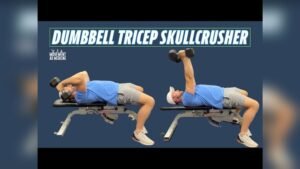
- Lie on a flat bench with your feet planted firmly on the floor.
- Hold a dumbbell in each hand.
- Extend your arms straight up, so dumbbells are above your chest.
- Palms can face each other (neutral grip) or face forward (pronated grip).
2. Lower The Dumbbells
- Keep your upper arms still.
- Bend your elbows and lower the dumbbells toward your forehead or slightly behind your head.
- Stop when your forearms are just past parallel to the floor.
- Avoid flaring your elbows out too wide; keep them pointed slightly inward.
3. Extend Your Arms
- Press the dumbbells back up by straightening your elbows.
- Keep your upper arms steady; don’t let them drift.
- Finish with arms fully extended but not locked.
4. Repeat
- Perform 8–15 reps per set.
- Complete 2–4 sets, resting 60–90 seconds between sets.
Example
Imagine you’re lying on a bench, holding two 10 kg dumbbells. You lower them slowly toward your forehead, pause, then push them back up. Your elbows stay in place, your arms feel the stretch, and your triceps work hard.
Tips For Proper Form
Skull crushers seem simple, but many beginners make mistakes. Here are tips to keep your form correct:
- Keep elbows steady: Moving your elbows reduces triceps activation.
- Lower weights slowly: This prevents injury and increases muscle tension.
- Don’t lock elbows: Locking can stress your joints.
- Use light weights first: Master the movement before using heavier weights.
- Control breathing: Inhale as you lower, exhale as you press up.
Common Mistakes And How To Avoid Them
Some errors happen often. Avoid these for safer, better results:
- Using too much weight: Start light to avoid injury.
- Flaring elbows: Keep them close to your head for best triceps activation.
- Moving upper arms: Only your forearms should move.
- Incomplete range: Lower the dumbbells fully for maximum stretch.
- Rushing reps: Slow, controlled movement is key.
Many beginners try to copy others in the gym, but not all examples are good. If you ever feel pain in your elbows or shoulders, stop and check your form.
How Skull Crushers Compare To Other Triceps Exercises
Skull crushers are not the only way to train your triceps. Let’s see how they stack up against other popular movements.
| Exercise | Main Muscles Worked | Equipment Needed | Difficulty |
|---|---|---|---|
| Skull Crushers (Dumbbells) | Triceps brachii (all heads) | Dumbbells, bench | Medium |
| Triceps Pushdown | Triceps (mainly lateral head) | Cable machine | Easy |
| Overhead Triceps Extension | Triceps (long head) | Dumbbell | Medium |
| Dips | Triceps, chest, shoulders | Parallel bars | Hard |
Skull crushers target all parts of the triceps and can be done almost anywhere. Compared to dips, they are easier for beginners. Unlike pushdowns, dumbbells offer more freedom for your wrists and arms.

Credit: www.hevyapp.com
Advanced Variations Of Skull Crushers
Once you master basic skull crushers, you can make them harder or more interesting. Here are some advanced variations:
1. Single-arm Skull Crushers
- Use one dumbbell at a time.
- Increases focus and corrects muscle imbalances.
2. Incline Bench Skull Crushers
- Lie on an incline bench.
- Changes the angle and targets the long head more.
3. Floor Skull Crushers
- Lie on the ground.
- Limits range but safer for elbows.
4. Cross-body Skull Crushers
- Lower dumbbells toward the opposite shoulder.
- Activates triceps differently.
You can also try supersets, combining skull crushers with other exercises, like push-ups or bench presses.
How To Add Skull Crushers To Your Workout
Skull crushers fit well in most upper body routines. Here’s how to include them:
- Place them after bigger movements, like bench presses or rows.
- Use moderate weights for 3–4 sets of 8–15 reps.
- Pair with other triceps exercises for a full workout.
Example workout:
- Bench Press – 3 sets of 10
- Skull Crushers – 3 sets of 12
- Triceps Pushdown – 2 sets of 15
If you train arms twice a week, do skull crushers once each session. Always rest at least 48 hours between heavy triceps workouts.
How To Progress Safely
Getting stronger takes time. To progress with skull crushers:
- Increase weight slowly, by 1–2 kg every few weeks.
- Add more reps or sets as you improve.
- Focus on form over speed or weight.
- Keep a training log to track progress.
Many beginners forget to record their workouts. Tracking helps you see gains and avoid repeating mistakes.
Skull Crushers For Different Fitness Levels
Skull crushers can be adjusted for any fitness level:
| Fitness Level | Recommended Weight | Reps/Sets | Variation |
|---|---|---|---|
| Beginner | 2–5 kg | 3×12 | Basic skull crusher |
| Intermediate | 6–10 kg | 4×10 | Incline bench |
| Advanced | 12+ kg | 4×8 | Single-arm, supersets |
Choose the variation and weight that matches your level. Increase difficulty as you gain confidence.
:max_bytes(150000):strip_icc()/94-3498313--Lying-triceps-extenGIF-0d0e624392d74f9897a698fbe5c4ea3b.gif)
Credit: www.verywellfit.com
Safety Tips And Injury Prevention
Skull crushers are safe when done right, but they can cause elbow pain if you rush or use bad form. Here’s how to prevent injuries:
- Warm up your elbows and shoulders before starting.
- Use proper form and avoid locking your joints.
- Don’t use heavy weights until you are confident.
- Stop if you feel sharp pain.
Research shows that triceps injuries are rare, but most happen from using too much weight or poor technique. If you have elbow issues, try floor skull crushers or skip the exercise.
How To Get Better Results
To get the most from skull crushers:
- Use full range of motion for maximum muscle stretch.
- Focus on the mind-muscle connection; feel your triceps working.
- Pair skull crushers with other triceps exercises for more growth.
- Eat enough protein to support muscle repair.
A common beginner mistake is not eating enough protein. Aim for 1. 2–1. 6 grams per kilogram of body weight daily for best results.
Science Behind Triceps Growth
Building muscle requires tension, stretch, and recovery. Skull crushers create high tension in the triceps, especially if you lower the dumbbells slowly. Studies show that exercises with a deep stretch, like skull crushers, increase muscle growth better than simple movements.
For more about muscle growth science, check this research article.
Frequently Asked Questions
How Often Should I Do Skull Crushers?
You can do skull crushers 1–2 times per week. Allow at least 48 hours between sessions for your triceps to recover.
Can Beginners Do Skull Crushers With Dumbbells?
Yes, beginners can start with light dumbbells (2–5 kg) and focus on form. It’s one of the best triceps exercises for all levels.
Are Skull Crushers Safe For Elbows?
Skull crushers are safe if you use proper form and don’t lock your elbows. If you have elbow pain, try floor skull crushers or use lighter weights.
Can I Do Skull Crushers Without A Bench?
Yes, you can do them on the floor, but your range of motion will be limited. A bench is best for full stretch and comfort.
What’s Better: Dumbbells Or Barbell For Skull Crushers?
Dumbbells are better for most people because they allow natural wrist movement and reduce injury risk. Barbells can work too, but some find them less comfortable.
Mastering skull crushers with dumbbells is a great way to build strong, defined triceps. Start light, use correct form, and increase difficulty slowly. With patience and practice, you’ll see real results and avoid common mistakes. If you want bigger arms or better pressing strength, skull crushers are a must-have in your routine.

Credit: www.youtube.com